Thursday, September 23, 2010

Publish MS Project 2010 Tasks to SharePoint 2007

Continuing on in our feature matrix, now we'd like to show how the IntelliGantt Add In for MS Project can publish tasks from MS Project 2010 to SharePoint 2007 task lists-- or to SharePoint 2010 task lists for that matter.

As you know, MS Project 2010 Professional now has the ability to synchronize project columns with SharePoint 2010 columns. But what about SharePoint 2007? Not supported. But we're happy to let you know that our IntelliGantt Add In for MS Project 2007 works just fine with MS Project 2010, Standard or Professional, which means you can still use those ancient SharePoint 2007 sites everyone has bookmarked in their web browsers.

You can install the IntelliGantt Add In for MS Project 2007 or for MS Project 2010. You can even start with MS Project 2007, install our Add In and then migrate to MS Project 2010 and still be connected to your SharePoint 2007 servers.

Let's see it in action.

First we will create a project with our 'compass' theme, this time focusing on the South.


When you install add ins with MS Project 2010, you get an 'Add-Ins' tab on the ribbon. The IntelliGantt Add In can be found here.


Just as you normally would, you use the 'Share Wizard' to select a SharePoint site and a task list.


This particlar task list is from one of the 'Fabulous Forty' templates that were available with SharePoint 2007 and contains tons of great features. (Note: I'm not sure if SharePoint 2010 has a Fabulous Forty as well. It seems like it should.) As you would expect, the tasks are in the Gantt view of this templates task list.


Of course, this view is still just as restrictive as all the SharePoint task views in that it doesn't really show you a full hierarchy and its dependencies. For that, we've created the IntelliGantt Web Part, which displays the full hierarchy and task predecessor links. This time, though, I'm going to show another feature-- our Explorer capability. Just click on the pith helmet and you'll see: Our SharePoint Explorer.


In this scenario we have a parent site called 'Demo' and four subsites named North, East, West and South. We've placed the IntelliGantt Web Part within the 'Demo' site, which is the parent site of both 'North' and 'South', in order to get a bigger view of the world. The SharePoint Explorer begins at the 'Demo' site, discovers all the sub sites with task lists and presents them. We simply mark the checkboxes we wish to see in our view, click 'OK' and...


... see the North and South united together. Talk about a powerful feature!

Friday, September 17, 2010

Publish MS Project 2007 Tasks to SharePoint 2010

Continuing to illustrate the combinations available to IntelliGantt, Microsoft Project and SharePoint users, today we will focus on publishing the full task hierarchy of a Microsoft Project 2007 plan to a SharePoint 2010 server. This is accomplished by the IntelliGantt Add In for MS Project, which actually works with both MS Project 2007 and MS Project 2010 (32-bit) versions and with SharePoint 2007 and SharePoint 2010. But in the interest of a shorter, more concise post we will focus on MS Project 2007, SharePoint 2010's improved task list and the powerful IntelliGantt Web Part.

First off is a simple project focusing on a few Eastern tasks created in MS Project 2007.


This is very similar to the 'North' project of the previous post in IntelliGantt, but we did add a new twist. Notice that in addition to predecessor links within a grouping we also have predecessor links spanning groups. For example, Trumbull is a predecessor of Boston. (Yes, I know this is not historically accurate. Boston was founded in 1630 and Trumbull was founded in 1797. Its just for demonstration purposes).

Next up we perform the standard IntelliGantt->Share steps to send our tasks in MS Project to a selected SharePoint list. As before, we will change the projects Workspace Settings to take advantage of new features in IntelliGantt and in SharePoint.


When we demonstrated IntelliGantt working with SharePoint 2007 we mentioned that IntelliGantt, during the Share operation, would create the 'Predecessors' column. With SharePoint 2010, this column is available to you out of the box and IntelliGantt will integrate with it. We also make sure to change the filter to 'Full Hierarchy', as before.

After IntelliGantt has sent the tasks to SharePoint, we see tasks in the improved gantt chart that comes with SharePoint 2010.


Here it is a little easier to distinguish the summary tasks from normal tasks because the visuals are a little better. However, you will still need to dive into each summary task to see its sub tasks, just as with SharePoint 2007.


Again, the task visuals have improved a bit as you can see the predecessors when both tasks are in the same group. However, remember the predecessors that spanned groups? For example, Trumbull being a predecessor to Boston? It's not viewable with the SharePoint 2010 task list.

This is where the IntelliGantt Web Part shines as it provides a full hierarchical view, which of course means it shows all predecessor links. The IntelliGantt Web Part brings all your project pieces into view.


Rest assured that this is just tip of the iceberg for what the IntelliGantt Web Part can do. Other features, such as the ability to add additional SharePoint task lists to the view will be demonstrated in a very near future blog post.

Wednesday, September 15, 2010

Publishing Project Task Hierarchies to SharePoint

Two questions for you:

1) How can you publish full project hierarchy to a SharePoint 2007 or SharePoint 2010 Task List?

2) How can you view a full project heirarchy in a SharePoint 2007 or SharePoint 2010 Task List?


The answers to question number 1 are:

IntelliGantt
Microsoft Project 2007 (Standard or Professional) with the IntelliGantt Add In
Microsoft Project 2010 Professional


The answer to question number 2 is:

The IntelliGantt Web Part


TeamDirection has created the next generation of SharePoint integrated Gantt Charts using Silverlight to bring you automatic updates, high-fidelity printing, dynamic timescale changes, future Windows Mobile 7 support and....

the ability to view a full project hierarchy in either SharePoint 2007 or SharePoint 2010.

Over the next few blog posts I will take you through the permutations of publishing projects to SharePoint and using the IntelliGantt Web Part to view them in their entirety.

First up is our IntelliGantt rich client application.


Here we have a four projects spanning the compass and are currently working on 'North'. Within North we have three northern states as summary tasks, three cities within each state and a few predecessor links. (Does this mean Ann Arbor precedes Detroit? Only in the alphabetical sense for this post-- people from Michigan, I mean you no harm :) ).

IntelliGantt has a very powerful 'Workspace Settings' screen that lets you configure all sorts of things. As of build 173 there are two significant features:


1) The new 'Full Hierarchy' task filter. This filter tells IntelliGantt to send the entire project, including the parent/child relationships between summary tasks and sub tasks, to any SharePoint task list of your choice.

2) The 'Predecessors' field, which has been upgraded to use a SharePoint lookup column in order to enhance usability and match MS Project 2010 SharePoint support.

Note that neither of these features are 'on' by default. This is because many folks are used to the flat listing of tasks in SharePoint and because, in order to dynamically create the Predecessors field (for SharePoint 2007), the IntelliGantt user will need at least 'Designer' permissions.


If you would like to see all the steps to publish a project with IntelliGantt, here is a screencast for you.


Once the project has been published, we can see the results in SharePoint:


OK, its a little underwhelming in the native, out-of-the-box SharePoint Gantt View. Believe it or not, the three 'state' tasks are indeed summary tasks containing sub tasks-- you'd just never know it in this UI. For example, you can click on 'Michigan' down at the bottom to see its contents:


However, you lose the context of the project-- notice that Wisconsin and Minnesota have disappeared? Also, remember that we created two predecessor links among the tasks? The task list in SharePoint 2007 does not show them.

How about a task list that shows the entire project? Like the IntelliGantt Web Part. For example, if I drop the IntelliGantt xap file into this SharePoint site I can get a great view of everything:


Here we see the entire project hierarchy with visual distinction among site, list and task item elements. Basic Red/Green colors show what is behind versus what is on track. Simple scrolling takes you up and down ALL your tasks (and we've tested with 10,000+). Predecessor links between tasks. And of course many more features that we will be showcasing.

The last thing I want to point out is, because the IntelliGantt Web Part is in fact a Silverlight application, you don't need to install it as a web part. You can in fact drop it into any SharePoint site, be it on a server down the hall, a 3rd party hosting provider or even Microsoft's BPOS solutions. Because of this flexibility you can use IntelliGantt's rich features for your project in any SharePoint hosting scenario.

We have detailed instructions written up for you for both SharePoint 2007 and SharePoint 2010.

Monday, August 09, 2010

SharePoint WSP Files for 2007 and 2010 Available

Beta 2 is looking good. We managed to squeeze that last feature in (enforcing task assignments so only folks assigned to a task can update it) and are in the final weeks of testing now. We have a couple nits beta testers have let us know about and vertical scrolling could still be a little faster, but overall we are very pleased and look forward to even more feedback.

We have identified three installation scenarios to support--

Installation on a Microsoft BPOS or 3rd party hosting solution
Installation on WSS 3.0 or MOSS 2007
Installation on SharePoint Foundation 2010 or SharePoint Server 2010

Because we are making the underlying IntelliGantt Web Part xap file available, you can install it on any SharePoint 2007 or SharePoint 2010 server anywhere! This will make it easy to 'kick the tires' or deploy the IntelliGantt Web Part for your immediate needs. Full instructions for installing the xap file are here.

If you do have administrative access to your SharePoint server, then installing the IntelliGantt Web Part makes sense as it will show up in the web part gallery in the 'Project Management' category.

Here is more information and the download link for the WSS 3.0/MOSS 2007 WSP file.

Here is more information and the download the link for the SharePoint Foundation/SharePoint Server 2010 WSP file.

Monday, August 02, 2010

Beta 2 of IntelliGantt Web Part Available

Just a quick note that we posted BETA 2 of the IntelliGantt Web Part tonight. Expect a WSP installer by Aug.4 and an additional search feature.

The high-value improvements in this beta are:

1. Navigation explorer to help you choose which sites/task lists to view (click on the pith helmet)
2. Helpful icons by each task that take you to the SharePoint item in your web browser when you click on it
3. Additional column types supported for search
4. Quick help on the search screen
5. Column width persistence for each SharePoint column

As you can see the pith helmet has replaced the arrow from Beta 1. This signifies the ability to explore your SharePoint site as opposed to pulling in everything. And yes, your selections will persist!

Wednesday, June 09, 2010

Using SharePoint Views to do a Simple Workflow

We just posted a couple screencasts to show how IntelliGantt can take advantage of two things:

1) The ability to work with any SharePoint view
2) Applying views to automatic refreshes

That's a little abstract so let me run through the scenario because the result is quite useful.

SharePoint 2010 introduces a new column in the task list called 'Predecessor'. (SharePoint 2007 doesn't have this by default, but IntelliGantt can add it for you). The idea here is to capture more schedule information in SharePoint. But other than drawing a pretty line from the finish date of one task to the start of the next, what is done with this data?

Well, IntelliGantt makes use of it to flip the Status of a task when its predecessor is marked as 'Completed'. Turns out computers are very adept at traversing dependencies and updating them when things change. So, IntelliGantt finds all the successors of a completed task and changes their status to 'In Progress'.

This in and of itself is interesting, but combined with a new SharePoint view and IntelliGantt's refresh logic the feature becomes dynamic.

That is to say, we create a view called 'My Tasks In Progress'. A SharePoint team member can then select this view in IntelliGantt and remove their hands from the keyboard and mouse. When predecessors to their tasks are completed, their own tasks will pop into view automatically. Team members don't have to click 'Refresh' constantly to see the latest. IntelliGantt keeps them up to date.

The result is the handoff between dependent tasks becomes that much more efficient. Even better, the team members don't have to change a thing-- IntelliGantt will do the handoff from one task to the next for them.

This is quite a bit to explain so please do see the 'SharePoint View' and 'Workflow Tasks' screencasts.

Wednesday, June 02, 2010

Searching SharePoint Task Lists

It's one thing to be able to view all your tasks in one spot, it's another to find the tasks most important to you. Given that SharePoint 2010 can now support millions of potential tasks at every level of a task hierarchy, a robust search solution is now critical to help users make sense of it all.

The IntelliGantt Web Part was designed with this exact scenario in mind. We just posted a new screencast highlighting the new 'Search' feature within the web part and, even after developing it, the coolness factor is at eleven!

Basically, it uses the one tried and true search metaphor the world has come to love-- a text box. OK, that in itself may seem underwhelming, but another design goal for the IntelliGantt Web Part was to make it as accessible as possible. Since everyone knows how to add keywords to a text box and search, it seemed like a natural.

Text based keywords, dates and date ranges are all supported. The date fields are parsed according to the locale on your system so folks in the US and folks in the EU both get their date formats exactly as they want them.

Searches are done using generated CAML queries so IntelliGantt never inundates the network with a huge volume of web services data just to iterate over all the SharePoint list items locally.

The coolest thing, though? After seeing the screencast, I think its the ability to 'splice' the search with a selected list view on the fly. For example, you can easily combine a 'My Tasks' view with a keyword value of 'In Progress', 'Behind' or a date range. This makes it easy for SharePoint users to create specific views for their needs, and a deviously clever way for users to add the extra bits they need to personalize things for them.

We're just begun with our search text box and look forward to adding more features and cleverness.

Tuesday, June 01, 2010

TeamDirection Site Updated for Web Part

Just a quick note to mention we have a landing page, screencast and demo page available that loads the IntelliGantt Web Part in your web browser for you to get look at.

Thursday, May 27, 2010

An Out of Browser Experience

Our new IntelliGantt Silverlight control takes advantage of a feature that let's you 'install' it on your desktop. This let's you use an icon on your desktop or start menu to launch the control-- basically as a 'super shortcut' to access your SharePoint data instead of going to the browser and navigating to the site (though yes, you could make the IntelliGantt web page a 'favorite' in your browser).

The other thing you get to do may actually be more important-- use your entire screen to view the IntelliGantt chart. Yes, maximizing the web browser gets you most of the way there, but as a 'desktop' application, you can actually use all the real estate on your monitor to get the biggest gantt chart possible. Which, if you have a large project plan, can be very helpful.

Here's what it looks like:

1. Start by navigating to the aspx page containing the IntelliGantt web part.


2. Next, right click anywhere within the IntelliGantt control. A two-item popup menu appears. The second item, whose full name is 'Install IntelliGantt Web Part for SharePoint onto this computer', is the one to select. This will not only install the control on your computer, it will also save the connection information so that the installed control automatically goes to this SharePoint site when its started.


3. After clicking on the menu option, a simple 'where do you want to put it?' dialog appears. The start menu is selected by default, but I prefer the desktop for my high value SharePoint sites.


4. Here is the final result. There is an 'IntelliGantt Web Part for SharePoint' icon that can be renamed to convey information as to what SharePoint site it came from. The title of the running app gives you a clue at least by providing the SharePoint server name.

Getting the task data from the SharePoint site was automatic as, during the process of installing on your desktop, IntelliGantt remembered where it came from and how to communicate with the SharePoint server in the future.

Also, you can install multiple controls from multiple sites and have them all run concurrently-- perhaps filling all the pixels on your multiple screens.


Finally, it's just as easy to uninstall is install. Whenever you want to remove it, go to your Control Panel. It will be listed as an application you can uninstall.

Wednesday, May 26, 2010

Installing the Silverlight Control on SharePoint 2010 and 2007

We just posted to our forum detailed steps how to install the IntelliGantt Web Part for SharePoint on both 2010 and 2007. Yes, we have the full matrix: Foundation, Standard and Enterprise 2010 are supported, as are WSS 3.0, MOSS Standard and MOSS Enterprise.

The idea here is a user will be able to drop the IntelliGantt control into a SharePoint server and evaluate how well it works for them without having to bug IT. But yes, we will have an actual package to install on SharePoint servers properly as well.

In the meantime, though, this is the method. It's straightforward on SharePoint 2010, but SharePoint 2007 makes you go through a particular hoop (which we've labelled as 'Step 13').

Finally, we encourage you to join our moderated forum, where we look forward to answering your questions and providing more in-depth information.

Monday, May 24, 2010

Microsoft BPOS and General SharePoint Hosting Support

I met with a local BPOS partner in town last week to show off the new IntelliGantt Web Part for SharePoint. For those who don't know what BPOS stands for, its a program from Microsoft for its partners to provide businesses productivity solutions through hosted services. There's a range of offerings from hosted Exchange to online Outlook. But of course we are most interested in the hosted SharePoint online services and the value we can bring to running projects online with SharePoint.

So when she asked me if the IntelliGantt web part runs on BPOS, first I had to ask what BPOS was myself, then I told her everything I knew, which amounted to 'I think so'. But 'should work' and 'does work' are often different things in this world so this morning I signed up for a BPOS account myself.

I'm pleased to say I was able to drop in the IntelliGantt Web Part, configure the MS.SP.url parameter and, lo and behold, it did indeed work. Here's the screenshot:


As you can see, not only is this running within the the BPOS environment (check out the size of that url!), but its also running with SSL-- another feature the IntelliGantt Web Part supports.

Finally, I'd like to show another image highlighting the bottom right of the Gantt chart:


By default you will see the words 'IntelliGantt BETA' on the bottom right of the Gantt chart. Furthermore, if you click on this, a browser window will open up taking you to a forum on the teamdirection.com site where you can post questions and look for answers.

For any SharePoint hoster and integrator (folks like Rackspace or Implement for example), this area of the Gantt chart-- the display string and the target link-- is customizable. Basically, we want to introduce a simple way for partners to 'brand' the IntelliGantt Web Part so that their name is visible and a link can take them to their website where they may help the customer with any questions.

The way to do this will be in the initParams value passed in to the IntelliGantt Web Part control. For example:

param name="initParams" value="BrandingText=Successful%20Partner,BrandingUri=[your uri]"

The result will be this:


Naturally this is just the start of the customizations we plan to do as initial states, color schemes and more all enter the mix. The order in which we do things will be driven by customer, and partner, demand.

Wednesday, May 19, 2010

IntelliGantt Web Part for SharePoint on a Mac

This just in-- Silverlight 4 works very well on a Mac with Safari!

I had to share a screenshot of our IntelliGantt Web Part talking to SharePoint and running on an Apple Mac:


Looks pretty good! Also, please notice that our web part is running inside of WSS 3.0 in this picture. I will post 'How-Tos' in the next couple days on how to site the control in SharePoint 2010, SharePoint Foundation 2010, MOSS 2007 and WSS 3.0.

Showing Rich Text in Tooltips

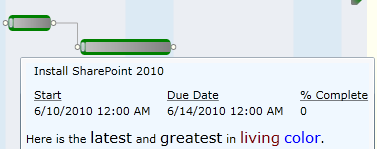
In my previous post I thanked Tim Heuer for creating the Floating Window control and letting us use it. This reminded me that I also need to thank David Anson for his excellent HTMLTextBlock control, which we are also using. It's what enables IntelliGantt to show the rich text content from SharePoint description fields within our 'super' tooltip.


HTMLTextBlock is great, and should also be added to the WPF Toolkit, in my humble opinion.

Tuesday, May 18, 2010

Searching for Tasks Through Sites and Subsites

As we've mentioned before while introducing the IntelliGantt Web Part for SharePoint, you have the option to look at all tasks within a SharePoint site, as below:


(Note: While it was cool to see the Gantt Chart on a SharePoint site's home page, I wanted it a little bigger. So I created a new Site Page, added the IntelliGantt Web Part and had it take up all the real estate).


You also have the option to drill down through sub sites and find all tasks from buried in your SharePoint hierarchy as well:


One of the first things you'll likely notice is you have a lot of tasks to look at! Wouldn't it be nice to have a search button that let's you search for simple keywords through all the tasks that IntelliGantt finds? We thought so too. The sharped eye'd reader will notice we've introduced a new button since the last blog post-- Search!


When you click on the magnifying glass, a floating window pops up that let's you enter keywords in a simple text box just like Google. (If you're thinking 'how did you do a floating window?', go see Tim Heuer's excellent blog post and codeplex project. And please vote for it to be included in the web toolkit!).


Type in a word or two that you'd like to find...


...and IntelliGantt will query your SharePoint server for tasks that have text fields matching your words.


Just in case you are wondering, IntelliGant did not pull down all items in the Task List from SharePoint and search for them locally, one at a time, on your computer. Instead, IntelliGantt created a CAML query that executed on the SharePoint server so that only results travelled across the wire. If that sounds a little too techie, just know that you're SharePoint administrator and IT networking folks will thank you!

The other really powerful feature of Search is to easily combine it with views, which often have their own search information defined.

In the above screenshots you'll notice we used the 'Default' view for each Task List, which is usually the 'All Tasks' view. However, we can also select 'My Tasks' and apply it to every Task List.


This is very helpful in and of itself as it makes it easy for every user to see what's assigned to them. But what if they wanted to see what's assigned to them on a certain date? Again, the Search is your friend.

Bring up the floating Search window once more by clicking on the magnifying glass and type in a date (IntelliGantt will recognize dates as well and apply it to your task Start and Due dates fields).


Execute the search and now we've made a more complex search-- all my tasks on 6/15-- surprisingly simple.


Of course the more sites, sub sites, task lists and tasks you have the more powerful this feature becomes. It's perfect both for team members who would like one place to see what they need to do and for managers who need one place to see what's been done.

Tuesday, May 11, 2010

Print the IntelliGantt SharePoint Gantt Chart

Not to give away my age, but back in the early 1990s we were on the cusp of the paperless office. By the mid-nineties we were on the precipice. At the end of the millenium the experts assured us that, after that Y2K thing caused everything to stop, when we restarted (rebooted?) the office would be absolutely, guaranteed, bet-your-bottom-dollar-on-it paperless.

In that context, we are pleased as punched that in the year 2010 Silverlight 4 now supports printing. I have to admit I like the theory of a paperless office, but I like the reality of what customers want even more-- and in no uncertain terms people want to capture our Gantt Charts on paper.

Now you can.


1) Go to a SharePoint site with the IntelliGantt Web Part for SharePoint installed.


2) Click the picture that looks like a printer.


3) Select a date range to print and a printer. By default IntelliGantt chooses the start and finish of the project. You can adjust this on the fly.


4) When you click 'Select Printer' the standard printer selection form in Windows pops up. I will choose a PDF for reasons that will be clear at the end of this post.


5) Since I chose PDF, it will ask me where I want to save it on disk. I find this step interesting because, remember, this is from a Silverlight application. Good golly, we can start to interact with the desktop. Awesome!


6) Here's probably the coolest visual part-- you can watch the pages being printed one at a time with a full preview for each page. If you see something you don't like, cancel it.


7) Voila, we are done! This example happens to be in PDF, but it just as easily could have been to your printer where the Gantt Chart would be waiting for you-- nice and warm in the print tray.


One thing to note about the output. Compare the visual in step 1 with the last visual above. Notice that the print output shows the complete Gantt Chart while the first image didn't have quite enough space for the start and finish dates? The print routine pays attention to the start and finish you specify in the print dialog and figures out what's necessary to print the range. Nice.

Of course, it's still hard to send paper through the internet. But I do have this PDF file! Which means if you want to see the actual PDF I just produced and print it for yourself, here you go.

Thursday, May 06, 2010

The IntelliGantt Web Part Within SharePoint

While a great looking and full-featured Gantt Chart has many merits on its own, if you're going to call something a Gantt Chart for SharePoint it's probably a good idea to actually show it within SharePoint. Not that I don't appreciate a good developer view now and then, but here's a screen capture of the IntelliGantt Web Part for SharePoint within SharePoint 2010.


The most important thing to note: This is not photoshopped!

I'll cover how to drop our web part within a SharePoint page in a separate post, but rest assured we're making it very easy for anyone to give the IntelliGantt Web Part for SharePoint a test run.

What I wanted to point out in this post is how this web part gives you a full visualization of the entire hierarchy. In this image you see six total items from the SharePoint site called 'SubSite 1', the task list called 'SubSite 1 Tasks' and the actual task items in the task list: Container, Chew Gum, Look and Walk. So far so good.

Since IntelliGantt gets its data from a SharePoint Task List, you can of course see the same data using just your web browser. However, when you navigate to the SharePoint Task List notice that only the three top-level items are visible: the Container folder, Look and Walk. The Container folder does indeed still contain sub tasks, but what you see in SharePoint is the following:


If we switch to the Gantt View for this list, we still just see the folder and 2 tasks:


IntelliGantt, on the other hand, gives you a complete view of your task hierarchy.


And naturally, the values roll up, like Start Date, Due Date and Percent Complete-- all reflecting the collection of child tasks. With this web part you can see all the tasks in your project just like you can in MS Project or IntelliGantt on the desktop.

Finally, we took this ability to its logical conclusion-- if you would like to see all the tasks in your project, then it stands to reason you might want to see all the tasks in your sub sites too. Just click the arrow next to the 'Views' dropdown (yes, that will be covered in another post) and IntelliGantt will discover the task lists lurking in your subsites and gather everything into one view.


Ah, I see that a few tasks we pulled in are behind. Looks like we have more work to do!

Wednesday, May 05, 2010

The Worlds Best SharePoint Gantt Chart

Coming soon to a browser near you.

I thought folks might like to see a peek of the new Gantt Chart TeamDirection is working on. We're calling it the IntelliGantt Web Part for SharePoint and have created a brand new section in our forum to start fielding questions.

Obviously we will have screencasts and tutorials. But here's what will be available from day one:

1) It is in Silverlight 4 and therefore will use the new PRINT capability

2) It will have interactive zoom in and zoom out to seamlessly move from hours to quarters when viewing your tasks. Gantt zooming is probably the number one request from folks interested in SharePoint Gantt Charts. It's really cool to see so I'm looking forward to demo'ing this feature!

3) All changes you do to the grid and gantt will be reflected immediately both in the UI and in the actual SharePoint item. No need to worry about clicking an 'Update' button, IntelliGantt figures it out for you.

4) You will be able to include subsites and all tasks from subsites in the web part with a click of a button (the arrow next to the print image. The preview picture below is actually including subsites.). This gives the IntelliGantt Web Part for SharePoint simple, yet powerful, rollup capability for any hiearchy of projects.

5) Did I mention beautiful printing?

6) Extremely intelligent auto-refresh features that automatically pull down all the data, or just the changes from the last time IntelliGantt refreshed.

7) Task grid columns that automatically configure based on SharePoint views.

8) Scaling, Scaling, Scaling. We've already tested the IntelliGantt Web Part for SharePoint with thousands of tasks with just about zero performance impact.

And of course much much more. Please contact sales at teamdirection dot com if you'd like to give the beta a test run. The first release will be targetted toward SharePoint 2010 (both Foundation and Server) with a follow on released supporting WSS 3.0 and MOSS 2007.

And finally, the picture:


Wednesday, March 03, 2010

Pre-Defined Workspace Settings

One of the most powerful features of IntelliGantt, the ability to adjust Workspace Settings, just got better. Customers loved the ability to configure Start Dates, Finish Dates and other fields to their custom sharepoint web parts, liked the ability to save their workspace settings as the new default but needed a better way to manipulate multiple configurations. We're happy to introduce Pre-Defined Workspace Settings.

The idea behind this feature is to more easily support custom lists that 3rd party vendors create. IntelliGantt is flexibile enough to handle just about any custom list you can create. However, it was proving arduous and mistake prone to go through the Workspace Settings and adjust them one-by-one. In this case, CorasWorks came to us and asked for a better way to support their Project Portfolio Management templates. As a result, we came up with a way to generate and use Predefined Settings, as highlighted in the image:


Rather than a single checkbox that let you 'Save to Defaults', now you can select the default, out-of-the-box configuration (which works with any default, out-of-the-box SharePoint task list). Or, you can select a configuration provided by a 3rd party or an in-house developer and all of the appropriate settings will be updated for you.


Notice in the last image that the Start Group, Finish Group and Effort Groups were changed based on the selection of 'Coras Works PPM - Push to Project'. Rather than having to generate this every time, a simple Pre-Defined Settings selection does the work for you.

Any Workspace Setting configuration can be captured by clicking the '+' button right by the words 'Pre-Defined Settings'. You can start with the default selection, do your mappings and click '+'. A form pops up showing you the current Workspace Settings templates you have available and let's you name the current configuration:


In this case CorasWorks wanted two Pre-Defined Workspace Settings-- one to do the initial publish and the second to handle subsequent synch operations. Once you have your settings named, click 'OK' and it will be available in the future.

If you'd like to distribute the Pre-Defined Workspace Settings to other users, that is possible as well. All Pre-Defined Workspace Settings are stored in a special directory under the current users data profile. For example, on Windows Vista/Windows 7, all these settings can be found at:

C:\Users\\AppData\Local\TeamDirection\IntelliGantt\Configuration\WorkspaceSettings

You can simply copy the pre-defined settings from your data directory to another users data directory. Then, the next time IntelliGantt is run, the Pre-Defined Workspace Settings you created and distributed will be available for that user.

We hope this feature encourages using IntelliGantt and the IntelliGantt Add In for MS Project with many custom SharePoint lists in the future.